The nitrogen cycle is the single most important thing to understand about a freshwater aquarium, and it's also the topic where the hobby's collective folk knowledge is most outdated. Most beginner guides — including ones still being written today — repeat a textbook explanation from the 1980s that has been definitively wrong for over twenty-five years. This article is going to give you the version of the cycle that actually matches what's happening in your tank.
The short version
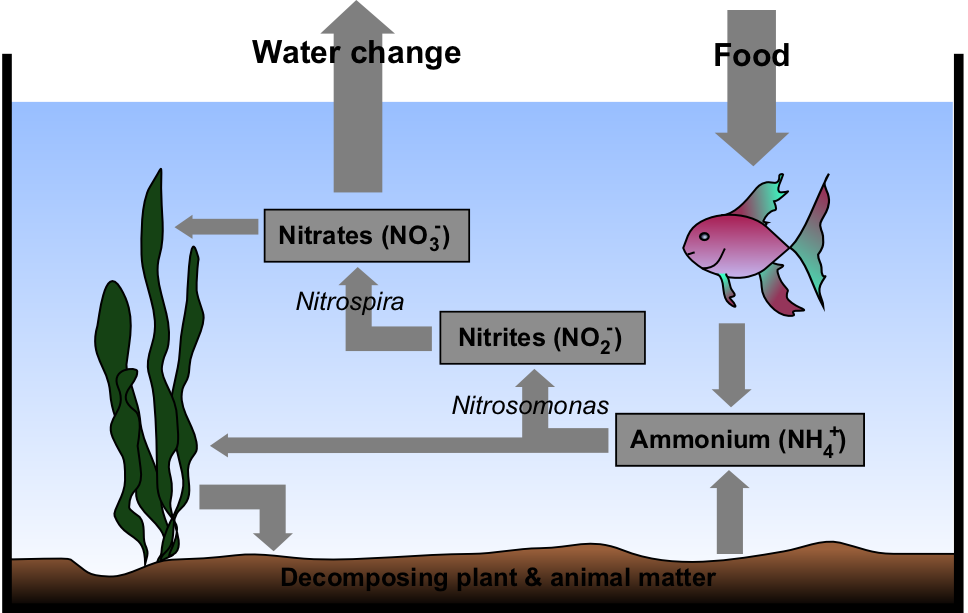
Fish produce ammonia. Ammonia is highly toxic. Bacteria living on every wet surface in your tank — your filter media, your substrate, your decor — convert that ammonia first into nitrite (also toxic) and then into nitrate (much less toxic). You remove the accumulated nitrate with water changes or live plants. That conversion process is called nitrification, and the population of bacteria doing the work is your biological filter.
When people say a tank is "cycled," they mean those bacterial populations are large enough to keep up with the ammonia production from your fish. When people say a tank is "cycling," they mean those populations are still being established, and ammonia or nitrite are accumulating to dangerous levels in the meantime. Cycling typically takes two to eight weeks. You cannot rush it meaningfully without seeding from an established system, though a few tricks can help.
That's the practical version. Now the part most articles get wrong.
Recommended gear for this article
All affiliate links · we earn a small commission at no cost to you



The bacteria you've been told about are mostly not in your tank
Almost every aquarium guide names two genera of bacteria as the workhorses of the nitrogen cycle: Nitrosomonas, which oxidizes ammonia into nitrite, and Nitrobacter, which oxidizes nitrite into nitrate. This pairing comes from soil and wastewater research that dates back nearly a century, and it was uncritically imported into the aquarium hobby because nobody had actually checked which species were doing the work in a fish tank.
In 1998, Dr. Timothy Hovanec and a team at UC Santa Barbara did check, using DNA-based methods that hadn't been available before. Their study observed that Nitrospira-like species rather than Nitrobacter species appeared responsible for oxidation of nitrite to nitrate in freshwater aquaria. Nitrobacter — the bacterium named in essentially every aquarium book and label ever printed — is not the dominant nitrite oxidizer in freshwater aquariums. Nitrospira is.
Subsequent work has gone further. Recent research found complete ammonia-oxidizing (comammox) Nitrospira present in all freshwater aquarium biofilter samples in high abundance, challenging our previous understanding of aquarium nitrification. "Comammox" — short for complete ammonia oxidation — refers to a single organism that can perform both steps of nitrification on its own, taking ammonia all the way to nitrate without a partner. These were only discovered in 2015. They appear to be a major presence in mature home aquariums.
The modern picture, then: your biofilter is a community. It includes ammonia-oxidizing bacteria (like Nitrosomonas), ammonia-oxidizing archaea (a separate domain of life that wasn't even known to participate in nitrification until the mid-2000s), and Nitrospira — some of which oxidize only nitrite and some of which handle the whole cycle themselves. A 2024 study monitoring three home aquariums over twelve weeks confirmed AOA (ammonia-oxidizing archaea) and comammox Nitrospira amoA genes in all aquariums.
Why does this matter to you, the person trying not to kill their fish? Two practical reasons.
First, many bacterial supplements sold to "instantly cycle" your tank were historically formulated around Nitrobacter, which doesn't actually establish well in freshwater aquariums. The products that work — Dr. Tim's One & Only is the most-cited example, partly because Hovanec himself developed it — contain the bacteria that actually live in tanks. If you're buying a starter, check what's in it.
Second, it explains why cycling is slow. Nitrite-oxidizing bacteria are slowly growing organisms with doubling times from 12 to 32 hours. Your biofilter doesn't double every 20 minutes like E. coli in a Petri dish; it doubles roughly once a day. That's why a fishless cycle takes weeks rather than hours.
Why ammonia kills
Ammonia in water exists in two forms that interconvert constantly: ionized ammonium (NH₄⁺) and un-ionized ammonia (NH₃). Your test kit measures both together, reported as Total Ammonia Nitrogen (TAN). The two forms have wildly different toxicity. The ionized form is relatively harmless. The un-ionized form is what damages gills and disrupts a fish's blood chemistry.
The ratio between the two depends on pH and temperature. As pH rises, more of your total ammonia exists in the toxic un-ionized form. As temperature rises, the same shift happens. This is why a reading of 1 ppm TAN at pH 6.5 and 72°F is much less dangerous than 1 ppm at pH 8.0 and 80°F. Same number on the test kit. Very different physiological reality.
The EPA's 2013 freshwater ammonia criteria, which are based on extensive toxicity testing across dozens of species, set the chronic criterion at 1.9 mg/L total ammonia nitrogen (TAN) at pH 7.0 and temperature 20°C, with the criterion adjusted by pH and temperature. As pH increases, organisms are more sensitive to ammonia. As temperature increases, invertebrates are more sensitive to ammonia. The takeaway for a hobbyist: any detectable ammonia is a problem worth addressing immediately, but it's an emergency at high pH and high temperature, not just a concern.
Cycling a new tank, the short way
There are two legitimate methods. Both work. One is faster.
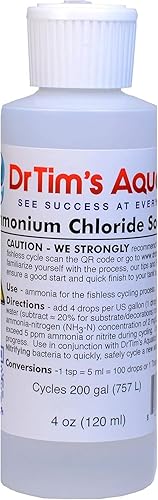
A fishless cycle uses pure ammonia (sold as janitorial-grade ammonium hydroxide, or as dosing solutions sold for this purpose) to feed the developing bacterial population. You add ammonia to roughly 2–4 ppm, wait, test daily, and watch the numbers. First ammonia drops to zero — that's the ammonia oxidizers establishing. Then nitrite spikes and eventually drops to zero — that's the nitrite oxidizers catching up. Once you can dose 2 ppm of ammonia and see both ammonia and nitrite drop to zero within 24 hours, your filter has the capacity to handle a typical fish load. Total time: four to eight weeks.
A seeded cycle dramatically shortens this. You take filter media, substrate, or even a sponge from an established healthy tank — yours or a friend's, or from a fish store willing to share — and put it in your new filter. The bacteria are already there; they just need to colonize the new surfaces. With enough seed material, a tank can be effectively cycled in days rather than weeks. The Hovanec & DeLong research explicitly identified this as the fastest route.
A fish-in cycle — adding a few hardy fish and letting their waste feed the bacteria — used to be the standard method and is still widely practiced. It works, but it subjects the fish to weeks of ammonia and nitrite exposure that ranges from stressful to lethal. There is no ethical version of this method that doesn't involve daily testing and aggressive water changes any time ammonia or nitrite climbs above 0.25 ppm. If you're going to do it, do it carefully, with hardy species, and don't pretend the fish aren't paying for your impatience.
What to actually monitor
For a new tank, test ammonia, nitrite, and nitrate daily until you understand what's happening. A liquid test kit (API Freshwater Master is the most common) is dramatically more reliable than test strips for these three parameters; the strips are notoriously inaccurate at low concentrations, which is exactly the range you care about.
For an established tank, weekly testing is sufficient under normal conditions. Test more often after any change: a new fish, a filter swap, a dead fish you might have missed, an unexplained behavior shift. Ammonia and nitrite should always read zero. Nitrate should accumulate slowly between water changes; how slowly depends on stocking, feeding, and plant load.
A general guideline: keep nitrate under 20 ppm for sensitive species (most shrimp, some plant-heavy display tanks), under 40 ppm for hardier community fish, and never above 80 ppm for anything. Plants reduce nitrate accumulation noticeably; a heavily planted tank may never need nitrate-driven water changes at all, though water changes still serve other purposes (replenishing trace elements, removing dissolved organics).
The single most useful thing to remember
The biological filter lives on surfaces, not in the water. When you do a water change, you're not disrupting your cycle — the bacteria stay put. When you replace your filter cartridge with a brand new one, on the other hand, you've thrown away a substantial fraction of your biofilter and your tank may briefly cycle again. Rinse media in tank water (never tap water, which contains chlorine that kills bacteria), and replace media gradually rather than all at once.
That single mental model — "the bacteria are on the surfaces, not in the water" — prevents about half the cycling disasters new fishkeepers run into.
Some links in this article are affiliate links — if you buy through them we earn a small commission at no extra cost to you. We only recommend gear we've personally used.